AI didn't make me faster at any one task. It made it cheap to leave one.
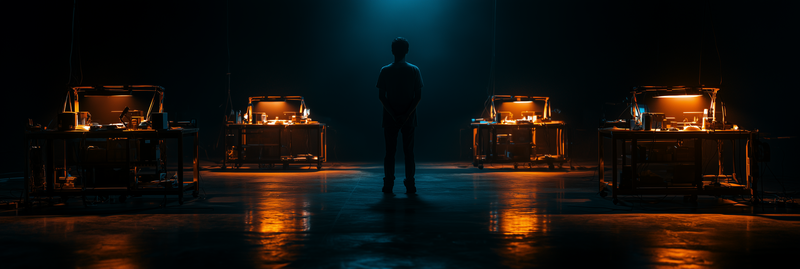
Right now I have four agents running on unrelated projects. Two coding, in different areas. One planning a new program, not the compute kind. One helping me write this post. They work until they finish or until they need me. Then they wait.
Dr. Sophie Leroy has a name for what that used to cost. She coined the term attention residue back in 2009, and she describes it as what happens when "part of our attention often stays with the prior task (Task A) instead of fully transferring to the next one (Task B)." Her research landed on something uncomfortable: "people need to stop thinking about one task in order to fully transition their attention and perform well on another." And we can't. The unfinished task follows us into the next one, and the work there suffers for it.
So here is what actually changed. The expensive part of switching was never the switch. It was the reload. Where was I, what did I decide, what was I about to do next.
My agents hold that now. I don't.
When I come back, my chief-of-staff agent hands me a short description of what got done and, if something is blocked, what I need to decide. I decide, or I argue with it first and then decide. Then they're back at work and I can move on without dropping anything.
There is a limit. Sometimes the question is hard and I have to sit with it for 15 or 30 minutes before I even understand what's being asked of me. That switch costs full price. Other times it's a yes or a no and I'm gone in twenty seconds. The cheap switches got cheap. The expensive ones are still expensive.
There's a good counter-argument going around and it's worth your time. The case is that AI makes an hour more fragmented, not less: "Each step may be faster than doing that step manually. But a given hour is more fragmented than in the past." It closes with this, which I think is exactly right: "Agents can run concurrently. Your attention should remain sequential."
I agree completely. That's the thing I'm describing. My attention is sequential. It's the context that runs in parallel, and it runs somewhere other than my head.
I still have to hold the big picture. Nobody is carrying that one for me. But I no longer have to hold four sets of details to keep four things moving.
Now go figure out what you can stop carrying.
Originally posted on LinkedIn: "What You Can Stop Carrying"